Like many cites London now has mobile reception on the underground. But is it as good as the service above ground? We tested this using SignalTrackerPro and it showed what 4G can do!
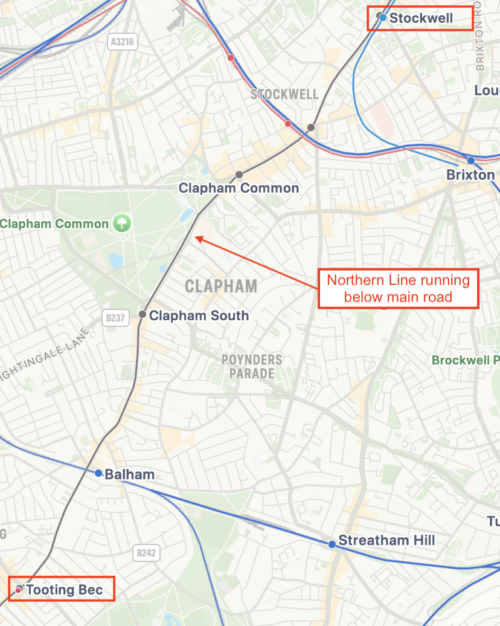
The Northern Line (Source: Apple maps)
The Northern Line was one of London’s first to benefit from mobile services and we tested a section of the line in south London between Tooting Bec and Stockwell stations. Here, the tube line runs directly underneath the road which connects the two stations.
SignalTrackerPro allows you to run automated tests every minute so we did this on the tube and compared it with operator’s outdoor performance on the road above. The app will show you download speeds, signal strength and mobile generation used in maps and graphs.
The results were very similar except in one aspect.
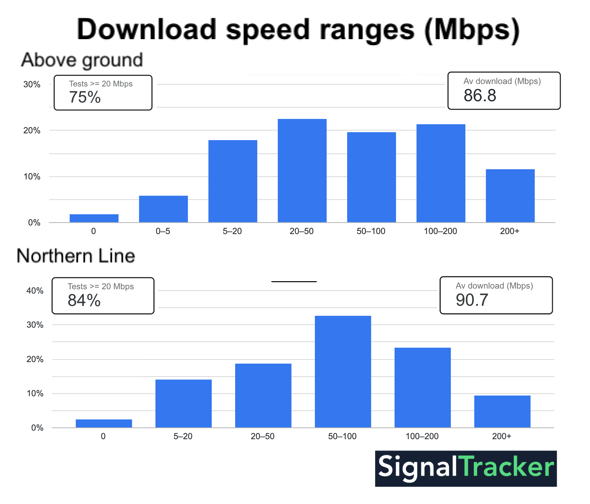
Download speeds were closely matched, as shown below. The tube results are slightly quicker because they have no very slow tests (0-5 Mbps), but they do not have quite as many very high speeds of over 200 Mbps.
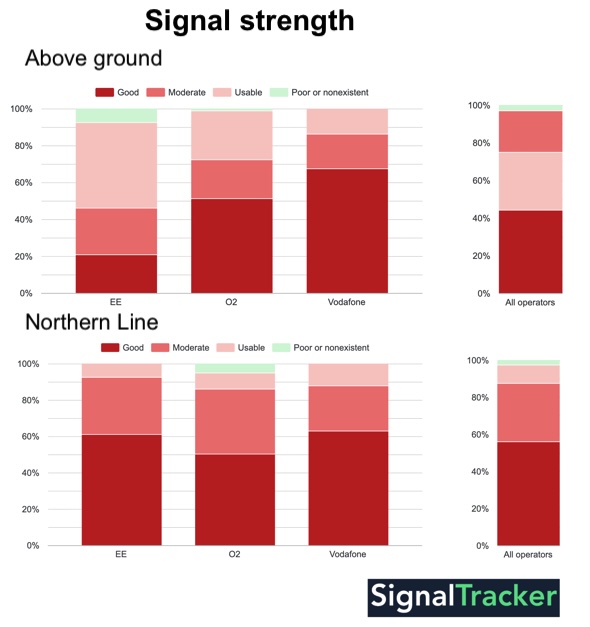
 When averaged across all operators, signal strength is slightly better on the tube. It is also more consistent. Below ground all operators are getting 50-60% of good results but on the surface this is more varied, as shown by EE getting only 20%.
The biggest difference is in the technology used. Above ground you will get 5G, under ground this happens a tiny fraction of the time, as shown below. However the effect on the user experience is minimal as the Northern Line download speeds – nearly all on 4G – are better than those above ground which have the benefit of the latest 5G technology.
Note: The tests were carried out in May and April 2026 using 5G standalone (5G SA) subscriptions from EE, O2 and Vodafone and 5G SA-compatible Samsung Galaxy phones.
